

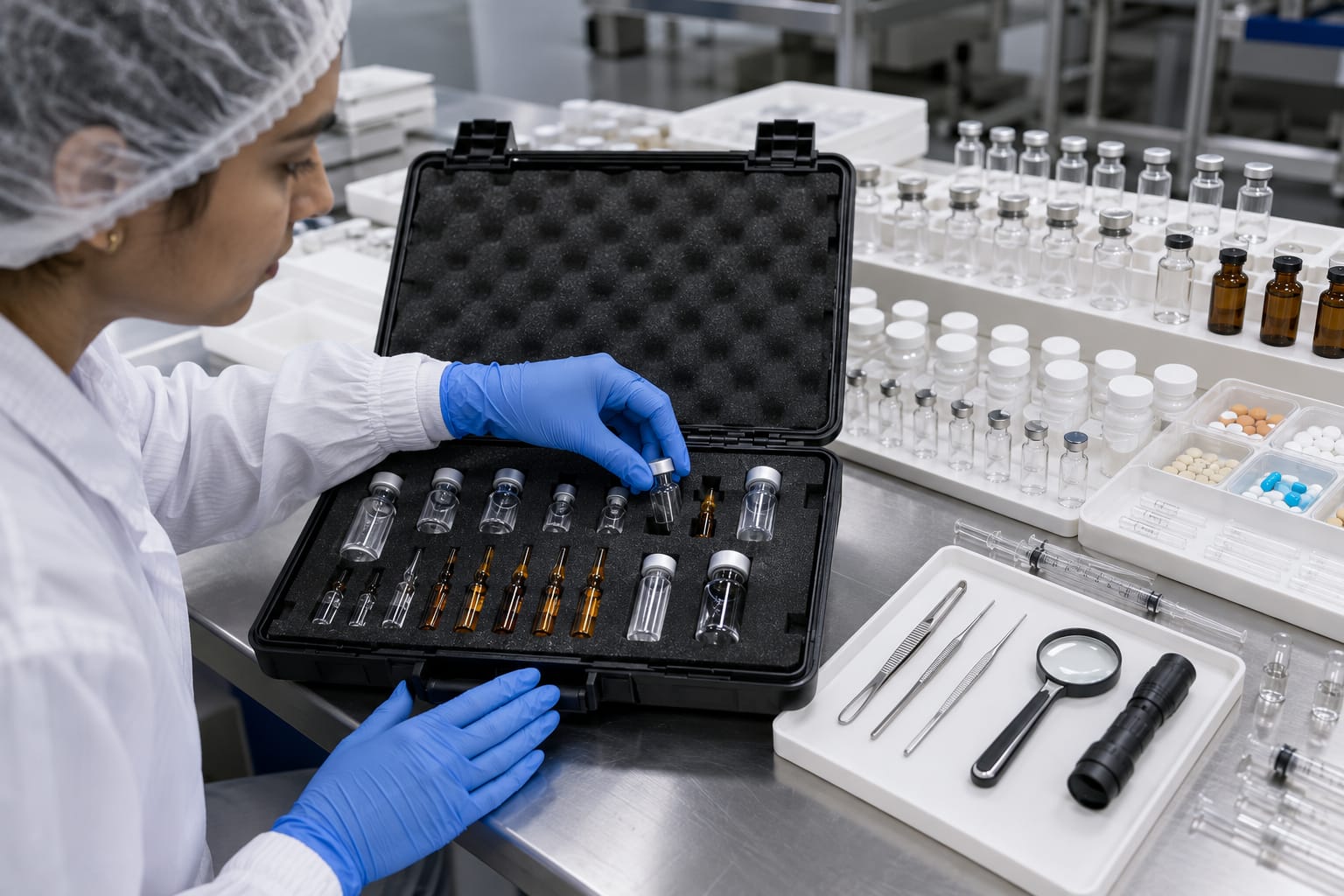
Premium Knapp Test Kits & Visual Inspection Standards for Pharmaceutical Manufacturing
Ensure complete regulatory compliance and optical precision with certified defect sets from a leading knapp test kit manufacturer. At FTI Incorporation, we design high-precision validation kits engineered specifically to meet stringent global standards, including USP 1790 qualification and EU GMP Annex 1 visual inspection guidelines.
Whether you require standard glass container calibration standards or a specialized prefilled syringe defect kit, our certified kits enable reliable operator training, automated inspection system validation, and robust quality assurance.
Visual inspection sits at the heart of parenteral safety. Every injectable, from a small-volume vial to a large-volume IV bag, must be examined so that no unit carrying visible particulate matter, a crack, or a compromised seal ever reaches a patient. Regulatory agencies worldwide — the US FDA, EU EMA, WHO, PIC/S, and PMDA — treat 100% visual inspection of parenterals as mandatory, and they expect manufacturers to prove, with documented evidence, that their inspectors and machines can actually detect the defects that matter. A validated Knapp test kit is the recognised tool for generating that proof.
Why Partner with a Leading Knapp Test Kit Supplier?
Visual inspection of parenteral products is a critical quality control step in pharmaceutical manufacturing. Partnering with a reliable knapp test kit supplier ensures your facility receives precisely controlled defect standards with fully traceable particle sizes, seal integrity flaws, and container abnormalities.
The Knapp test itself — formally the Knapp–Kushner methodology — was developed to replace subjective, pass/fail inspection with a statistically defensible measure of detection performance. By presenting inspectors and machines with a known population of defective and defect-free units, each carrying an established probability of detection, the method produces a Reject Zone Efficiency (RZE) score that benchmarks any inspection process against a manually determined baseline. This is the scientific foundation your auditors expect to see, and it is why a generic sample set cannot substitute for a properly characterised kit.
As a trusted knapp test kit manufacturer, we deliver customized and standard sets that streamline your facility’s validation protocols. Our test kits feature:
1. Certified Defect Libraries:
Accurately sized micro-particles, cosmetic glass flaws, and closure integrity defects, each characterised and documented so that every unit in the set behaves predictably across repeated inspection cycles.
2. Regulatory Alignment:
Built to support full compliance with USP 1790 qualification standards, and aligned with USP <790>, EU GMP Annex 1, Ph. Eur. 2.9.20, and JP 6.06 for globally harmonised programs.
3. Versatile Formulations:
Applicable for clear liquid solutions, suspensions, lyophilized products, and biologics, including difficult-to-inspect matrices such as amber containers, coloured solutions, and protein formulations prone to inherent haze.
4. Traceable Documentation:
Detailed certificates of analysis (CoA) for seamless audit readiness, including particle composition, microscopic dimensional measurements, defect positions, and full lot traceability.
Achieving Compliance with USP 1790 Qualification & Annex 1
Modern parenteral production demands rigorous validation for both manual visual inspection qualification processes and automated visual inspection (AVI) machinery. Implementing a comprehensive USP 1790 qualification routine allows quality control teams to establish clear probability of detection (POD) curves and maintain robust inspection standards.
USP <1790> frames visual inspection as a lifecycle activity rather than a single test. It covers inspector qualification and re-qualification, the control of inspection conditions such as illumination and viewing time, the classification of defects by risk, and the ongoing monitoring of detection capability. A well-designed Knapp kit maps directly onto each of these requirements: it supplies the characterised defects for qualification, the known-probability units for calculating POD, and the documented traceability that closes the loop during an audit.
Furthermore, revised cGMP regulations place heavy emphasis on EU GMP Annex 1 visual inspection requirements. Adhering to Annex 1 visual inspection rules requires ongoing human operator re-qualification, secondary inspection protocols, and continuous monitoring of particle contamination risks. The 2023 revision of Annex 1 strengthened the expectation for a holistic contamination control strategy, placing visual inspection firmly within a documented, risk-based framework. Our customized Knapp test sets provide the precise baseline needed to satisfy regulatory auditors worldwide, and our technical team can advise on how to integrate kit data into your contamination control strategy and periodic review cycle.
Customized Prefilled Syringe Defect Kits & Container Standards
Different drug delivery formats present unique inspection challenges. Prefilled syringes, in particular, require specialized evaluation due to needle shields, plunger stoppers, silicone oil droplets, and narrow barrel geometries.
Our specialized prefilled syringe defect kit options include targeted standards for:
1. Particulate Defects:
Extraneous fibers, glass fragments, stainless steel particles, and rubber shed, reproduced across a controlled size range so inspectors are challenged from the limit of detection upward.
2. Container & Closure Flaws:
Barrel cracks, flange chips, tip cap issues, and improper stopper positioning, together with cosmetic glass defects such as airlines, blisters, stones, and surface abrasions.
3. Syringe-Specific Anomalies:
Silicone layer irregularities, air bubble differentiation, and liquid fill level variations, including the subtle distinction between genuine particulates and mobile silicone droplets that so often drives false rejects.
Each prefilled syringe defect kit is manufactured under controlled cleanroom conditions to ensure long-term stability and precise defect representation for your validation team. These kits can be combined with a certified particle challenge set for complete particulate library coverage.
A Complete Defect Taxonomy in Every Kit
A kit is only as credible as the defects it contains. FTI builds its sets around a complete, risk-classified defect taxonomy so your qualification reflects the contamination your line actually produces:
- Particulate defects: black particles, white particles, metal particles, glass particles, rubber particles, and embedded particles, each traceable to a likely source such as equipment, closures, or the environment.
- Fibre and hair defects: black fibres, white fibres, lint fibres, and human hair, sized to reflect their real elongated geometry.
- Glass and forming defects: stones, airlines, blisters, discoloured glass, heel stickers, lack of concentricity, surface abrasions, and cracks or checks graded by penetration and by location (body, heel, shoulder/neck).
- Crimp, cap, and closure defects: scored, malformed, dented, gouged, scalloped, cut, and knurling crimp defects, dented collars, bruised seals, flip-off seal blemishes, and stopper defects.
- Cosmetic and fill defects: colour variation, stains, scratches, high and low fill volume, and empty units.
Each defect is assigned a criticality grade — critical, major, or minor — so your kit is weighted toward the defects that carry the greatest patient risk, exactly as USP <1790> and your acceptable quality limits require.
Choose FTI Incorporation as Your Trusted Knapp Test Kit Supplier
As a pioneer in pharmaceutical testing solutions, FTI Incorporation is proud to be a reliable knapp test kit supplier serving global parenteral manufacturers, contract development and manufacturing organizations (CDMOs), and testing laboratories. We provide specialized sets engineered for both manual teams and automated visual inspection qualification standards.
Incubated at the National Forensic Sciences University, FTI combines deep analytical expertise with practical manufacturing experience, and our kits are backed by on-site training, 24/7 technical support, and audit-ready documentation. With offices in India, the USA, and Europe, we support programs across regulated markets worldwide.
Our Complete Product & Service Scope:
- Custom Knapp defect sets for vials, ampoules, cartridges, and prefilled syringes.
- Operator qualification and re-certification test sets.
- Automated inspection machine calibration sets.
- Consultation on USP 1790 qualification protocols and Annex 1 visual inspection program setup.
- Particle characterization and foreign-matter identification for unknown contaminants.
- Plant-specific contact and non-contact material library kits for root-cause investigations.
Frequently Asked Questions
A standard set produced by a knapp test kit manufacturer contains a balanced ratio of known defect-free containers and precisely created defect samples (ranging from subtle to obvious particulate and physical flaws). These sets are used to evaluate operator inspection accuracy using Knapp-Kushner testing methodology, and each unit carries an established probability of detection so that a Reject Zone Efficiency score can be calculated and defended in audit.
Syringes feature complex components like plunger stoppers and needle shields that interact differently under inspection lighting compared to standard vials. A dedicated prefilled syringe defect kit provides realistic defect models tailored to syringe geometries to ensure accurate detection rates, including the silicone oil droplets and air bubbles that are the most common cause of false rejects in syringe lines.
Our defect sets allow facilities to maintain continuous operator qualification and machine validation as mandated under EU GMP Annex 1 visual inspection guidelines, ensuring your continuous quality control process meets modern regulatory expectations. They also provide the documented, risk-based evidence that the revised Annex 1 contamination control strategy requires.
A traditional Knapp test set typically consists of 100 to 200 containers, with roughly 10% to 20% containing known, characterizable defects. This statistical distribution allows quality teams to accurately calculate Probability of Detection (POD) and operator efficiency without biasing inspectors toward over-rejection.
Yes. We manufacture custom test sets using your specified container types—vials, ampoules, cartridges, or prefilled syringes—and can fill them with your actual drug matrix, placebo, or Water for Injection (WFI) to reflect exact production conditions, including matching turbidity, viscosity, and colour for difficult-to-inspect products.
Every test kit includes a comprehensive Certificate of Analysis (CoA) detailing particle composition, microscopic dimensional measurements, container positions, and analytical traceability to satisfy regulatory audits.
Test kits should undergo periodic inspection and re-certification annually to ensure fluid clarity, particle stability, and container closure integrity remain uncompromised over time. Most organisations assign a defined validity period, typically 18 to 24 months, after which the kit is reviewed, re-certified, or replaced.
Yes. We offer tailored defect libraries specifically designed for manual visual inspection qualifications as well as high-speed spin-compatible sets for calibrating automated visual inspection machinery.
Kits can include the full taxonomy of parenteral defects: particulates (glass, metal, rubber, fibre, hair), glass-forming defects (stones, airlines, blisters, cracks and checks), crimp and seal defects, and cosmetic and fill-level defects, each sized and risk-graded to match your process.
Our kits serve sterile injectable manufacturers, biologics and vaccine producers, CDMOs, ophthalmic and BFS manufacturers, and independent testing laboratories qualifying both human inspectors and automated systems.


Contact Us Today
Ready to elevate your visual inspection validation framework? Contact our technical team today to request a quote or discuss a custom defect kit tailored to your specific drug product line.