


Certified Material Library Kits & Custom Particle Challenge Sets
Validate your parenteral visual inspection systems and operator proficiency with precision-engineered particle reference standards from FTI Incorporation. Extraneous particulate matter in injectable drug formulations poses severe patient safety risks and remains a primary cause of regulatory audit citations and product recalls.
Our comprehensive material library standards provide fully characterized particulate samples across diverse material compositions, particle sizes, and container geometries. Whether you require standards for manual visual inspection qualification, automated vision system calibration, or probability of detection (POD) studies, a certified particle challenge set from FTI Incorporation delivers predictable, reproducible validation data.
A plant-specific material library goes a step further than a generic defect set: it is a characterised reference collection of the materials actually present in your facility — both product-contact materials such as stoppers, gaskets, tubing, filters, and glass, and non-contact materials such as garments, wipes, and gloves. When an unknown particle appears in a batch, it can be matched against this library to pinpoint its source, turning a slow root-cause investigation into a direct comparison.
The Role of a Calibrated Particle Challenge Set in Quality Assurance
Both manual operators and high-speed automated visual inspection (AVI) systems must be systematically challenged using realistic particulate defects from an avi qualification kit.
At FTI Incorporation, each particle challenge set is produced under controlled cleanroom conditions using certified seed materials suspended in authentic production containers. Key features include:
- Diverse Material Libraries: Intrinsic and extrinsic particulate types, including glass splinters, stainless steel shavings, rubber stopper fragments, cellulose fibers, and plastic polymers.
- Traceable Dimensional Sizing: Particle dimensions accurately sized from sub-visible micro-particles up to macro-visible particulate standards.
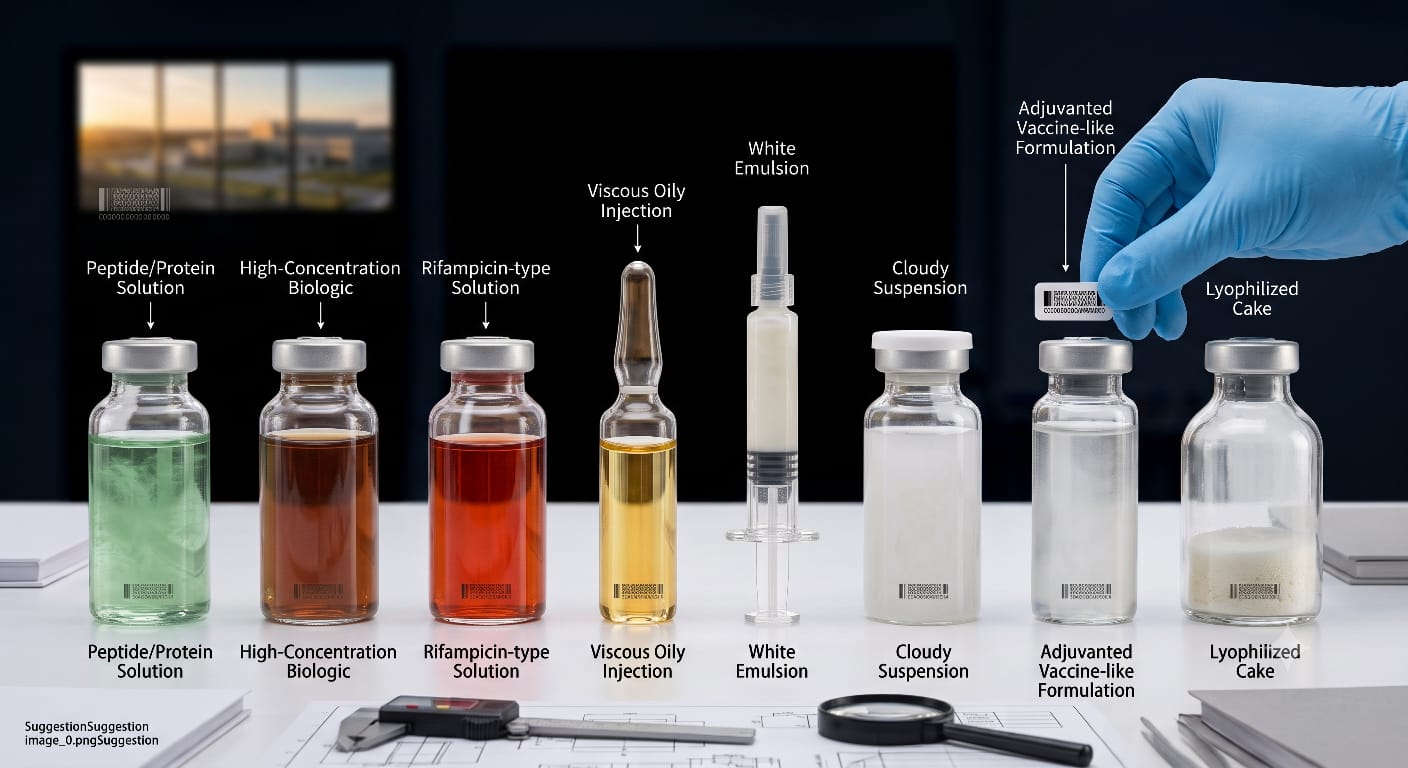
- Matrix & Liquid Matching: Formulations available in water-for-injection (WFI), high-viscosity solutions, or custom liquid matrices matching your specific drug product properties.
- Audit-Ready Certification: Supplied with full Certificates of Analysis (CoA) detailing particle morphology, sizing measurements, and material composition traceability.
Understanding Particle Sources: Extrinsic, Intrinsic, and Inherent
Effective contamination control begins with knowing where a particle came from. Our material libraries represent all three recognised source categories: extrinsic particles foreign to the process (hair, environmental fibres, dust), intrinsic particles from the process and contact materials (glass, rubber, metal, silicone), and inherent particles arising from the formulation itself (protein aggregates, precipitates). Representing each category in your challenge set ensures inspectors and machines are trained against the full spectrum of real-world contamination, and supports the Technically Unavoidable Particle Profile (TUPP) assessments regulators increasingly expect.
Material Library Applications across Parenteral Manufacturing
Deploying standardized particle standards ensures robust quality assurance across every stage of pharmaceutical packaging:
- Operator Onboarding & Re-Qualification: Evaluating human inspector visual acuity, light-contrast sensitivity, and detection accuracy under usp 790 visual inspection viewing standards.
- Automated Vision System Calibration: Fine-tuning camera exposure settings, lighting angles, and image-processing algorithms to distinguish true contaminants from benign air bubbles.
- Probability of Detection (POD) Curves: Plotting statistical detection confidence levels across a range of particle sizes and material reflectivities.
- Root-Cause Contamination Investigations: Matching an unknown particle recovered from a batch against the plant-specific library to identify its origin and drive effective CAPA.
Choose FTI Incorporation for Your Particle Standards
FTI Incorporation is a trusted knapp test kit supplier and provider of specialized validation standards for global pharmaceutical companies, CDMOs, and packaging equipment manufacturers. Our technical engineering team collaborates directly with your Quality Assurance staff to build custom material library sets tailored to your specific container formats—including vials, ampoules, cartridges, and prefilled syringes. Where a particle cannot be identified from the library alone, our analytical laboratory can characterise it by SEM-EDX and FTIR to confirm its composition and likely source.